You met someone. You got on well. You told them things you would not tell an ordinary supplier: that your father is ill and that the photo with him is the one that matters, that you and your sister have not spoken in two years so better not to push it, that your mother will fall apart the moment the ceremony starts.
The wedding day arrives and somebody else turns up.
It is not that they are a worse photographer. They might even be better. It is that they have no idea what they are looking at. They do not know which of the two hundred guests is your father, or why that photo matters more than the rest.
This article is not about subcontracting being wrong. It is about a question almost no couple asks and everyone should: who will actually be there. Further down you will find the five questions worth asking before you sign, what the contract should say, and what you can still do if you have already signed.
Subcontracting is not the problem
Let us start here, because this is the part that gets misread most often.
There are studios that work with several photographers and do it impeccably. The couple knows from the first meeting, sees the portfolio of the specific person who will shoot their wedding, meets them beforehand and chooses them. That is not a trick, it is a perfectly legitimate business model, and some people run it at a very high standard.
The problem is not that somebody else turns up.
The problem is not knowing.
And there is a second problem almost nobody mentions: if you do not know, you have not seen their work either. It could be a professional with fifteen years of weddings behind them, or someone who has been in the industry for six months and got the call the Tuesday before. You have no way of telling, because nobody told you it was going to happen.
The three situations you may run into
1. The multi-photographer studio, declared
You sign knowing the brand has a team. They show you the portfolio of the person who will shoot your wedding, not the studio’s greatest hits. You can meet them beforehand. If it does not click, you ask for someone else.
Nothing wrong here. You know what you are buying.
How to spot it: they talk in the plural from the first meeting and give you a specific name without you having to ask.
2. The multi-photographer studio, undeclared
You sign with a brand believing you are signing with a person, because that person is the one who met you, showed you their work and clicked with you. On the day, someone else shows up.
Nobody lied to you outright. They simply let you believe something that was not true, and nobody bothered to correct it.
How to spot it: the website and the quote only ever carry the brand name, never a person’s, and when you ask who is coming the answer changes the subject.
3. The diary that does not add up
Someone takes on more weddings than their real team can cover and fills the gaps however they can, sometimes with people hired that same week. Here the two worst things come together: the person shooting knows nothing about you, and you have never seen a single photo of theirs.
On top of that, the person you spoke to and paid will not set foot in your wedding.
How to spot it: they accept your date instantly without checking anything, and their social media shows several different weddings from the same weekend.
Why it matters so much who is there
Talking about “a connection” with your photographer sounds like brochure language. It is not. It has very concrete consequences for the photos you end up with.
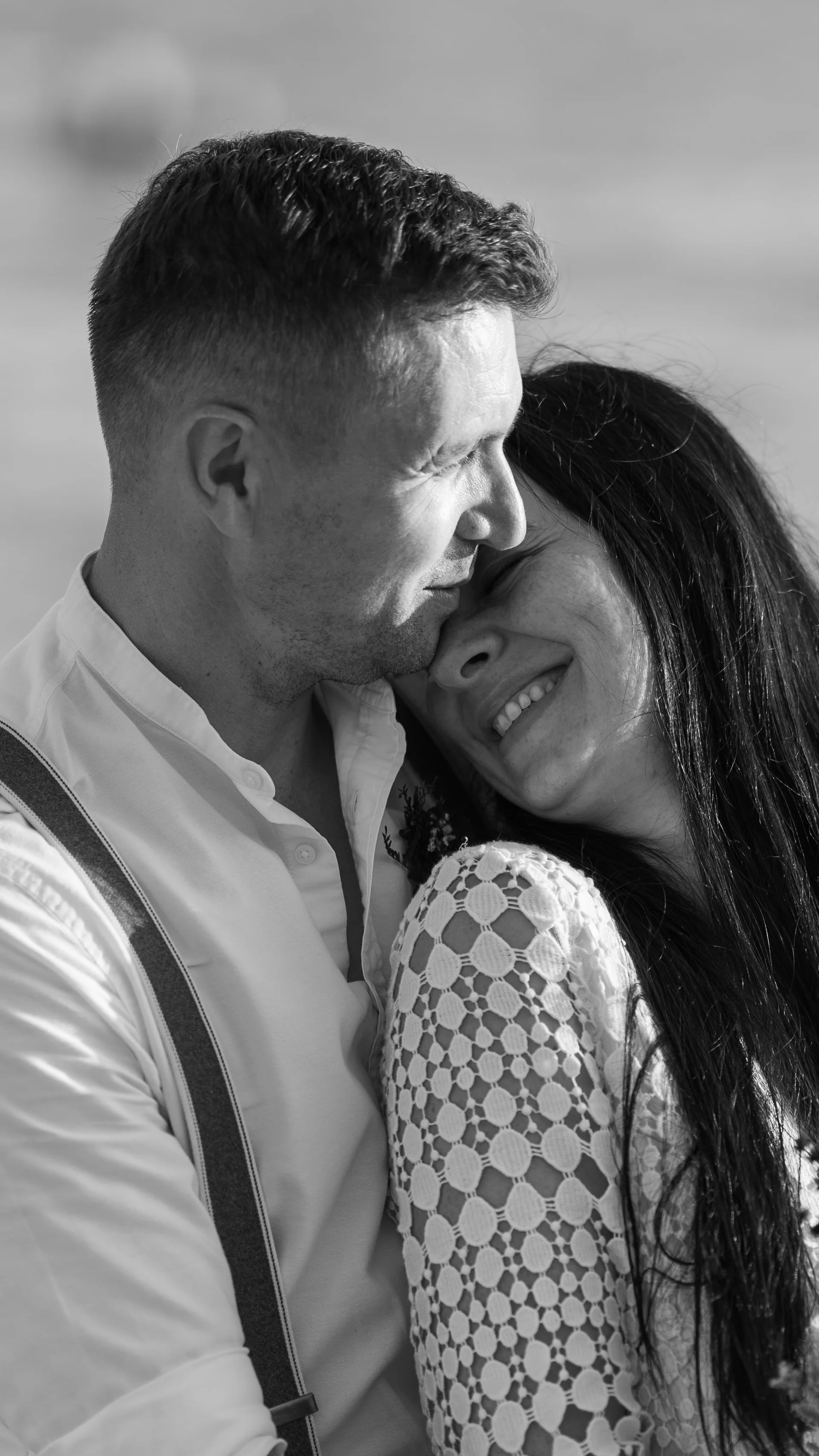
Anticipation runs on information. Turning towards a mother in the exact second her face breaks only happens if the photographer knows who she is and knows she has been holding it in all morning. Otherwise, by the time they turn, it is over. Nobody improvises that: they know because somebody told them months earlier.
Knowing the venue changes the photos. In our wedding timeline guide we explain that a civil ceremony should start two to two and a half hours before sunset so the portraits land in the golden hour. That is the theory, and it works at any wedding. What actually changes the photos is the rest: knowing that this particular courtyard is already in shade by then, that the good wall is round the back, and that it takes five minutes to walk from the ceremony exit to the right olive tree. You learn that by having been there, not by looking it up.
Your guests behave differently. People relax around someone they have already met, even for half an hour. In front of a stranger with a camera, they stiffen up. You can see it in the pictures, and no amount of editing fixes it.
And the important one: none of this transfers over WhatsApp the night before. There is no way to hand someone, in a message, everything you have told your photographer over the course of a year.
Five questions before you sign
None of these questions is rude. They are the same ones you would ask before hiring anyone for something that cannot be repeated.
| Question | An answer that should worry you |
|---|---|
| Who exactly is coming on my wedding day? | “We’ll assign someone closer to the date” |
| Can I meet that person before I sign? | “No need, we all work the same way” |
| How many weddings is that person covering that day? | More than one, or an answer about the company instead of about them |
| Can I see a full wedding of theirs, not just the best shots? | “I’ll send you the studio portfolio” |
| What happens if they fall ill? | Having no answer ready |
Look closely at the third one. What matters is not how many weddings the company has in the diary, but how many the person coming to yours is covering. A studio can have three weddings on a Saturday and be doing everything right, as long as each one has a different person there all day. What it cannot do is split one person between two places.
The fourth deserves a note too. A portfolio is the twenty best photos from five years. A full wedding, start to finish, is what you will actually receive. They are different things, and asking to see a complete one is the most reasonable request in the world.
Good answers to all of this are specific and rather boring: a name, a link to a complete gallery, a clear sentence about what happens if someone falls ill. When an answer comes back vague, it is almost never because they do not know it.
What the contract should say
Here is the part almost nobody publishes, and the one that genuinely protects you:
- The name of the person covering the wedding, not just the company name. If the contract only names a brand, the brand can send whoever it likes.
- Exactly what happens if that person cannot attend. Who picks the replacement, how much notice you get, and whether you can say no.
- How many hours of coverage and with how many people. “Full coverage” means nothing. A full wedding runs ten to fourteen hours, from getting ready to the party, so that number is worth seeing in writing.
- Who edits the photos. Sometimes one person shoots and another edits, with a different eye. The final result does not look like the portfolio you saw.
Asking for a name in the contract is not distrust. It is the normal way to hire any service where the specific person matters.
If you have already signed
Plenty of people get here after the deposit has been paid, and at that point the question stops being what to ask and becomes what can still be done. Quite a lot, as it happens:
Ask for the name in writing, even now. A two-line email asking who has been assigned to you. Having it in writing already changes things, and the reply will tell you a great deal on its own.
Ask to see a full wedding by that person. If they send it over without blinking, breathe out. If they send you the studio portfolio again, push once more.
Reread your contract looking for the word substitution. See whether it says who picks the replacement and whether you get a say. If it says nothing, email them and ask them to confirm the procedure. An answered email counts as evidence.
And ask to meet that person, even for half an hour on a video call. Almost nobody says no to that, and half an hour is infinitely better than nothing.
None of this is picking a fight. It is putting in writing something that should have been clear from the start.
How we do it
If we are going to ask for transparency, we start with our own.
There are two of us: Ferran shoots the photography and Eric the film. When a couple books us for both, that date is blocked and we do not offer it to anyone else. There is no second wedding that day.
The only exception is when each of us is booked separately for a single service: Eric filming one wedding and Ferran photographing another. Two weddings on the calendar that day, yes, but each of us at one wedding only, for the whole day. We never split a day between two weddings.
We subcontract in one case and one case only: when the couple asks us for a second photographer. A professional joins us, and the couple knows because they are the ones who asked. We never send someone in our place without saying so.
And the part we cannot promise: we have never missed a wedding through illness, but nobody can guarantee it will never happen. What we can tell you is what we would do. We have contacts among photographers in the area whose work we genuinely know. We would call you ourselves, show you their work, and the decision would be yours. That is the most honest thing anyone can offer.

If you want to go deeper into the rest of the decision, it is all in seven mistakes when hiring a wedding photographer and videographer and in how to choose a team in Tarragona.
The one door that cannot be reopened
By far the most likely outcome is that everything goes well. Most people in this industry work seriously and will tell you who is coming to your wedding the moment you ask.
But of everything you book for a wedding, this is the only thing that gets no second chance. The catering can be complained about the next day. The flowers wilt either way. If the music is not working, you fix it halfway through the party. With the photos and the film there is no second take: either somebody was there looking in the right direction, or that moment does not exist.
That is why it is worth spending five minutes on an awkward question before you sign. Five minutes against the one thing from the day that cannot be done again.
Frequently asked questions
Is it bad for a wedding photographer to subcontract? Not necessarily. Plenty of multi-photographer studios work very well and deliver excellent results. What makes the difference is transparency: being told from the start, seeing the specific work of the person shooting your wedding, and being able to choose. The model is not the problem, finding out on the day is.
How do I know who will photograph my wedding? Ask directly and request that the name appears in the contract. If the answer is that it will be assigned later, you are buying a brand, not a person. That is legitimate, but you should know before you sign rather than afterwards.
How many weddings can a photographer cover in one day? One. A full wedding runs ten to fourteen hours, from getting ready to the party, so a single person cannot stretch across two places: they arrive late, leave early, or send someone. A studio having several weddings on the same day with a different photographer at each is a different thing entirely, and perfectly reasonable. The right question is not how many weddings the company has, but how many the person coming to yours is covering.
Can I ask for the photographer’s name in the contract? Yes, and it is standard practice in any service where the specific person matters. Also ask it to specify what happens if that person cannot attend: who proposes the replacement and whether you can turn them down.
What happens if my photographer falls ill on the wedding day? A serious professional has that answer ready before you ask: a network of trusted colleagues, an immediate call to the couple, and the final say in your hands. The worrying part is not that it could happen, because it can happen to anyone. The worrying part is having no plan.
Can I cancel if they change my photographer? It depends on what your contract says. If it names a specific person, you have a solid argument, because the substitution changes the thing you booked. If it only names a company, it is much harder. This is not legal advice, and the first step is always to talk to them: most of the time a conversation settles it. It is, in any case, the best reason to get the name in writing on day one.
Is it rude to ask all this? No. A professional who works transparently welcomes these questions, because they are exactly what sets them apart from someone who cannot answer them. And if one of them makes the person in front of you uncomfortable, that discomfort is already an answer.
If you have doubts about what you have already booked, or you would like to talk about your wedding with someone who has been to a lot of them, get in touch.